
MVP Development: How to Build and Validate Your App Idea
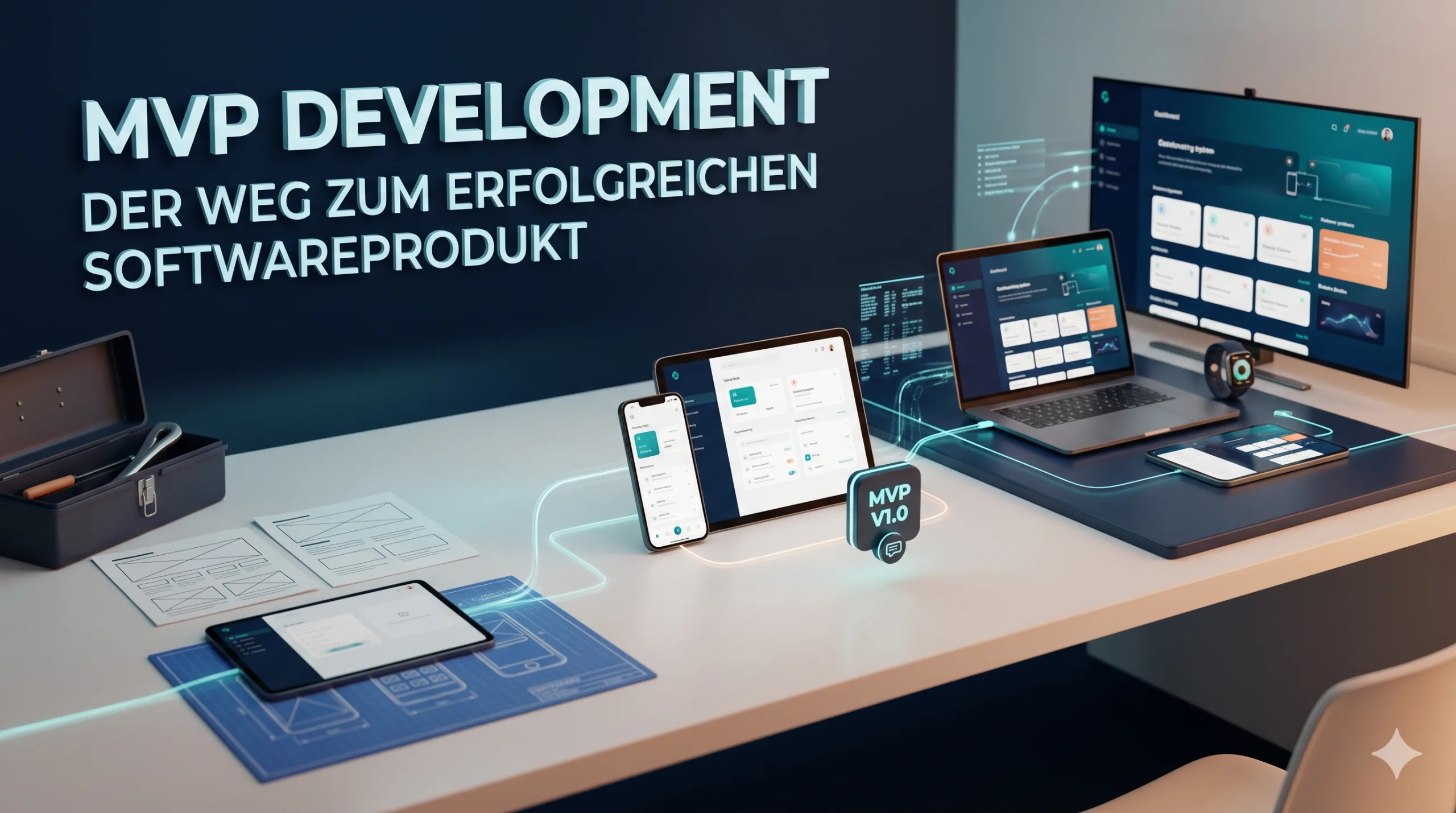 AI generated
 Did you know that, according to recent studies, more than 40 percent of all startups fail because they build a product there is simply no market for? When it comes to launching new digital products, MVP development is often the deciding factor between an expensive dead end and a scalable success. Instead of spending months or even years behind closed doors building the supposedly perfect product, modern companies rely on agility and real user feedback.
In this comprehensive guide, founders, CTOs and business decision-makers will learn how to get their vision on the road efficiently with a Minimum Viable Product (MVP). This article walks through the key phases, the usual stumbling blocks and how to allocate your resources so that you convince investors and first customers alike.
What exactly is MVP development?
MVP stands for Minimum Viable Product. MVP development means building a first version of your web or mobile app with exactly the features needed to solve the core problem of your target group. No more and no less.
A widespread misconception is that an MVP is an unfinished or faulty product. The opposite is true: the „V“ in MVP stands for „viable“, meaning usable and working. It has to deliver genuine value to users from day one. Think of the well-known transport analogy: if your end goal is a car, your MVP is not a single wheel. A wheel does not get anyone from A to B. Instead, you build a skateboard. It is simple, it has no doors and no engine, but it fulfils the basic purpose of moving someone forward.
Why MVP development is critical for your project
Choosing an MVP approach offers enormous strategic advantages to startups and established companies alike. Here are the four most important reasons to take this route:
1. Drastically reduced risk
Developing a full-scope software solution quickly swallows six-figure budgets. If you only discover after launch that your target group does not need certain features at all, or that the business model does not work, that capital is gone. An MVP tests your hypotheses with minimal financial exposure.
2. Faster user feedback (build-measure-learn)
The heart of the lean startup methodology is the build-measure-learn cycle. The sooner you put your product into the hands of real users, the sooner you learn. You gain valuable data on how your app is actually used, which functions are missing and which are superfluous. That feedback is worth its weight in gold for the rest of your roadmap.
3. Optimal cost efficiency
By limiting yourself to the absolute core functions, you save valuable development time and therefore real money. You can invest that saved budget later, in a targeted way, into the features your users are actively asking for.
4. Faster time to market
In today’s digital economy, speed is a decisive competitive advantage. With an MVP you are often on the market within a few weeks or months. You can generate first revenue, establish your brand and win over investors with real traction (user numbers, revenue) instead of a business plan alone.
The MVP development process in 6 steps
A successful MVP is not the result of chance but of a structured process. At SB-Techworks we have refined this process across a large number of projects.
Step 1: Define the problem and the target group
Before the first line of code is written, you need to lay the foundation. Which specific problem are you solving? Who are you solving it for? Create detailed user personas and analyse the competition. Your MVP has to provide a clear answer to a pressing pain point.
Step 2: Identify the core features (MoSCoW method)
This is where the wheat is separated from the chaff. Write down every feature you would like to have and apply the MoSCoW method:
- Must-have: Indispensable functions without which the product is useless (these make up your MVP).
- Should-have: Important functions that are still allowed to be missing in version 1.0.
- Could-have: Nice-to-haves that get added if the budget allows.
- Won’t-have: Functions that are ignored completely for now.
Step 3: User journey and UI/UX design
An MVP still has to be intuitive to use. Map out the path your users take through the app. Create wireframes and clickable prototypes. A clean, focused design builds trust with your first users, the early adopters.
Step 4: Technical development (agile)
Now the actual MVP development begins. Choosing the right tech stack is essential here. For mobile apps, cross-platform technologies such as React Native or Flutter are often a good fit, because they let you build for iOS and Android at the same time. Development should run in agile sprints so that you can react flexibly to changes.
Step 5: Quality assurance (testing)
An MVP is allowed to have a reduced feature set, but it is not allowed to be full of bugs. A broken app frustrates users immediately and distorts your feedback. Thorough testing, both manual and automated, is therefore mandatory even for an MVP.
Step 6: Launch and data analysis
After launch, the most important phase begins: measuring. Implement analytics tools (such as Google Analytics, Mixpanel or Amplitude) right from the start. Track KPIs such as customer acquisition cost (CAC), churn rate and user behaviour inside the app.
Common mistakes in MVP development (and how to avoid them)
Despite the best intentions, many founders walk into the same traps. Watch out for these three common mistakes:
- Feature creep: The temptation to add „just this one more feature“ before going live is strong. Stay disciplined. Every additional feature delays the launch and drives up costs.
- Poor quality: An MVP is not a free pass for bad code or terrible design. If the core function does not work smoothly, users will leave before they ever see the value of your product.
- Ignoring user feedback: The whole point of an MVP is learning. If you ignore what early adopters tell you and stubbornly stick to your original plan, you miss the target entirely.
Your partner for successful MVP development: SB-Techworks
Delivering a Minimum Viable Product takes more than technical expertise; it takes strategic thinking as well. That is exactly where we come in. With SB-Techworks as your partner for web and mobile app development, you work directly with a developer who knows precisely where the line between „minimum“ and „viable“ runs.
We support you from the first validation of your idea through UI/UX design to agile software development and a successful launch. My goal is to hand you a scalable technical architecture that works as an MVP today and forms the foundation of your growing business tomorrow.
Conclusion: start small, scale big
Professional MVP development is the smartest way to validate digital product ideas. It protects your capital, accelerates your market entry and makes sure you build a solution your customers genuinely love. Do you have a brilliant app idea but no idea where to start? Get in touch with SB-Techworks for a no-obligation initial consultation, and let us turn your vision into reality together.
Frequently asked questions
What does MVP development cost?
The cost of an MVP depends heavily on the complexity of the core features, the platform you choose (web, iOS, Android) and how demanding the design is. As a rule, professionally built MVPs range between €15,000 and €50,000. A precise estimate is only possible after a detailed requirements analysis.
How long does it take to develop an MVP?
The primary goal of an MVP is a fast market entry. A typical development cycle for a Minimum Viable Product runs between 8 and 12 weeks, from concept to finished launch. Complex projects in fintech or medtech can take somewhat longer because of compliance requirements.
Does an MVP only make sense for startups?
No, not at all. Established mid-sized companies and large corporations also use MVP strategies to test new digital business models, internal tools or innovative customer apps at low risk before releasing large budgets.
What happens after the MVP launch?
After launch, iterative development begins. You collect data on user behaviour, run interviews and evaluate feedback. Based on those insights you plan the next development sprints, optimise existing functions and add new, validated features step by step.