
AFIR Countdown: What CPOs Must Implement by April 2026
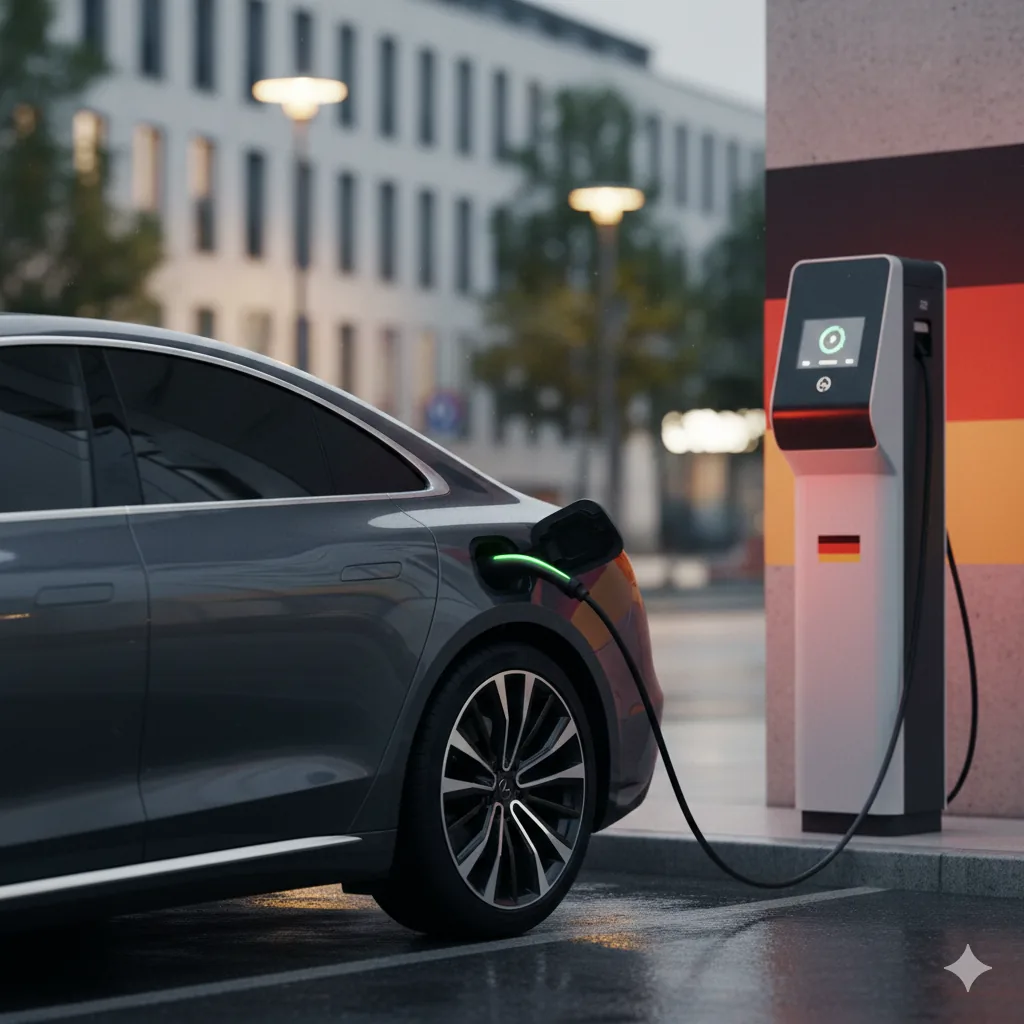 AI generated
 Electric mobility in Europe is accelerating fast, and with that growth come new regulatory requirements. One of the most significant of these is the EU’s Alternative Fuels Infrastructure Regulation (AFIR). The clock is ticking, because a decisive deadline is drawing closer. Many charge point operators (CPOs) are therefore asking themselves, when it comes to AFIR, what CPOs must implement by April 2026 in order to stay compliant and remain competitive. This article gives you a comprehensive guide to the obligations ahead and shows you how to meet them.
What is AFIR, and why does it matter so much for CPOs?
AFIR is an EU regulation aimed at creating a dense, reliable and user-friendly network of charging and refuelling infrastructure for alternative fuels across Europe. It replaces the earlier directive (AFID) and, unlike a directive, sets binding rules that apply directly in every member state. The goal is to put an end to the „charging chaos“ and to strengthen consumer confidence in e-mobility.
The core objectives of the EU regulation
AFIR pursues several main objectives that are aimed directly at charge point operators (CPOs):
- Simplified charging and payment: every EV driver should be able to charge and pay at any public charge point without complications, with no prior registration or contract.
- Price transparency: the cost of a charging session must be communicated clearly and understandably before it begins.
- Interoperability and roaming: a seamless charging experience across national and operator boundaries should become the norm.
- Data availability: static and dynamic data about charge points (location, availability, price) must be made publicly accessible.
The key dates at a glance
While AFIR has already applied to all *newly* built charge points since April 2024, the decisive deadline for existing installations is 13 April 2026. By that date, CPOs must have retrofitted their existing infrastructure to meet the new requirements. Postponing is not an option, because non-compliance can result in severe penalties.
AFIR: what CPOs must implement by April 2026 in concrete terms
The requirements of the regulation are detailed and have considerable technical and operational consequences. Below, we break down the most important points that are relevant to you as a CPO.
1. Ad-hoc charging without mandatory registration
At the heart of AFIR is the demand for barrier-free access. EV drivers must no longer be forced to register with countless providers or download their apps.
At publicly accessible charge points, operators must enable ad-hoc charging by means of a commonly used payment instrument.
In practice, this means:
- For charging power below 50 kW: a dynamic QR code solution that takes the user to a website (web app) for payment processing is sufficient here. A physical card terminal is not strictly necessary.
- For charging power of 50 kW and above: these charge points (mostly DC fast chargers) must be equipped with a card reader for contactless payments (debit/credit card) or with a payment terminal supporting contact-based cards. This has applied to new installations since April 2024, and existing installations must be retrofitted by April 2026.
2. Consistent and transparent pricing
Hidden costs and opaque pricing models are meant to become a thing of the past. AFIR stipulates that all price components must be shown to the user *before* the charging session starts. This includes:
- Price per kilowatt-hour (kWh)
- Price per minute (where applicable)
- Price per charging session (session fee)
- Any blocking fees once the charging session has ended
The information must be displayed directly at the charge point, for example on a screen, on the payment terminal, or on the web-based payment page opened via the QR code.
3. Requirements for connectivity and data provision
Modern charging infrastructure has to be „smart“. AFIR requires all publicly accessible charge points to be digitally connected and capable of smart charging. Beyond that, CPOs are obliged to transmit data to the relevant national access points (in Germany, the Bundesnetzagentur, the federal network agency). This includes:
- Static data: location, operator information, connector types, maximum charging power.
- Dynamic data: operational status (available/occupied/out of service), ad-hoc charging price.
This data feeds into central databases and navigation systems in order to make route planning easier for EV drivers.
Don’t forget metrology law compliance!
Alongside AFIR, compliance with German metrology law (Eichrecht) remains an important requirement. It ensures that the amount of energy consumed is measured and billed correctly. Modern backend systems must be able to satisfy both the AFIR requirements and the metrology law rules.
Technical challenges and solutions for CPOs
Implementing the AFIR requirements puts many operators up against technical hurdles. Retrofitting hardware is expensive, and the software requirements are complex. The key to success lies in a flexible, future-proof backend system (CSMS, or charge station management system).
The central role of modern backend systems (CSMS)
A capable CSMS is the brain of your charging infrastructure. To be AFIR-compliant, your system has to handle the following:
- Flexible payment gateway: integration of various payment service providers for card terminals and web-based solutions.
- Dynamic price management: the ability to control prices centrally and display them transparently at the charge point.
- OCPI interface: the Open Charge Point Interface (OCPI) is the de facto standard for roaming and for data exchange between CPOs and e-mobility service providers (eMSPs).
- Data reporting: automated delivery of the required static and dynamic data to the national access points.
Retrofitting: software update or hardware replacement?
When it comes to the question of how AFIR compliance can be achieved, CPOs often face a choice: is a software update enough, or does expensive hardware have to be replaced? The answer depends heavily on the existing infrastructure. Frequently, a combination of both is necessary. Retrofitting payment terminals on DC charge points in particular involves considerable cost and effort.
How SB-Techworks can support CPOs with the switch to AFIR
Implementing AFIR is first and foremost a technological challenge, and one that calls for deep software expertise. As a specialist in the development of web and mobile applications, particularly in the field of connected systems, SB-Techworks is the ideal partner for CPOs. We help you not just to clear the AFIR hurdles, but to use them as an opportunity to modernise your systems. My services cover the development and integration of tailor-made software solutions that fit seamlessly into your existing infrastructure, from connecting payment terminals to your backend through to building compliant web payment applications and ensuring data exchange via OCPI.
Conclusion: act now so you are ready for April 2026
The question of AFIR and what CPOs must implement by April 2026 is no longer a theoretical one; it demands concrete action. The regulation certainly brings challenges with it, but it also offers a major opportunity to decisively improve the user experience across the charging network and make electric mobility attractive to a much broader audience. CPOs who invest now in flexible, software-driven and open infrastructure secure not only legal compliance but also a decisive competitive advantage.
Don’t wait until the deadline has passed. Start analysing your infrastructure and planning the necessary steps today. If you need support with the technical concept and its implementation, SB-Techworks is at your side. Get in touch for a no-obligation consultation to make your charging infrastructure future-proof.
Frequently asked questions about AFIR
Does every charge point really have to get a card terminal?
No. The obligation to fit a card reader or payment terminal applies to all *newly* installed public charge points with an output of 50 kW or more. Existing charge points in this power class must be retrofitted by 13 April 2026. For charge points with an output below 50 kW, a web-based solution reachable via QR code is sufficient.
What happens if I don’t meet the AFIR requirements by April 2026?
Enforcement of AFIR is the responsibility of the individual EU member states. It is safe to assume that non-compliance will be met with substantial fines. In addition, non-compliant CPOs risk being excluded from roaming platforms and navigation services, which would lead to a considerable loss of customers and revenue.
What is the difference between AFIR and the German Charging Point Ordinance (Ladesäulenverordnung, LSV)?
AFIR is an EU regulation and therefore has direct legal force in all member states. It takes precedence over national law. The German LSV has pursued similar goals in the past, but AFIR largely supersedes and harmonises it. AFIR sets a single, Europe-wide standard, whereas the LSV applied only in Germany.